

TL;DR:
- Landlords in London must ensure properties meet EPC C standards by 2026 to avoid fines.
- Checking EPCs via postcode is quick, accurate, and essential for compliance and planning upgrades.
- Proactive upgrades and regular EPC checks help landlords prevent fines and enhance property value.
From 2026, landlords letting new tenancies in London must hold a minimum EPC C rating or face fines of up to £5,000. If your property sits at D or E, that is not a distant problem. It is an immediate one. An EPC check by postcode takes minutes and gives you a clear picture of where your property stands, what your certificate says, and what upgrades could push your rating higher. This guide covers everything you need: why EPC ratings matter now, how to prepare, the exact steps to run a postcode check, and how to act on what you find.
Table of Contents
- Why your EPC matters now more than ever
- What you need for an EPC check by postcode
- Step-by-step: How to complete an EPC check by postcode
- After the check: Planning upgrades and avoiding common pitfalls
- Our view on EPC checks: Why the postcode method is your fastest route to compliance
- Get expert help with your EPC in London
- Frequently asked questions
Key Takeaways
| Point | Details |
|---|---|
| Check EPC by postcode | A postcode search gives you instant access to official EPC details and compliance status. |
| Prioritise upgrades now | Use your EPC report to plan and budget energy improvements, not just tick a regulatory box. |
| London rules changing | From 2026, new rentals must legally have at least EPC C or face fines of up to £5,000 and letting restrictions. |
| Compliance boosts value | A higher EPC rating not only meets legal requirements but also makes your property more valuable and marketable. |
Why your EPC matters now more than ever
With compliance stakes so high, it is critical to understand the EPC landscape and what it means for your property portfolio.
The Minimum Energy Efficiency Standards, known as MEES, have raised the bar for landlords across England and Wales. The old threshold of EPC E is no longer sufficient. From 2026, new rental agreements require a minimum EPC C rating, and existing tenancies are expected to follow by 2028. For London landlords, this is particularly pressing. Older Victorian and Edwardian terraces, purpose-built flats from the 1960s and 1970s, and converted properties tend to score D or E on the EPC scale. Many fall short without owners even realising it.
The financial stakes are real. Landlords face fines up to £5,000 if properties do not meet MEES requirements from 2026, and most London properties currently lag behind the required standard. Beyond fines, a poor EPC rating affects your ability to market the property, secure competitive mortgage rates, and attract quality tenants who are increasingly energy-conscious.
Stat to know: Most UK homes currently sit below EPC C. In London, where older housing stock dominates, this figure is even higher, meaning the majority of landlords need to take action before the deadline.
Here is what your EPC rating directly influences:
- Legal compliance: You cannot let a property without a valid EPC meeting minimum standards.
- Property value: Higher-rated homes command better prices and attract more buyers.
- Rental income potential: Energy-efficient homes are more attractive to tenants, supporting higher rents.
- Mortgage accessibility: Some lenders now offer preferential rates for properties rated C or above.
- Marketability: Estate agents increasingly highlight EPC ratings as a key selling point.
Checking your London EPC rating requirements before you invest in upgrades helps you prioritise spending and avoid costly surprises at point of sale or tenancy renewal.
What you need for an EPC check by postcode
Understanding why EPC matters, let us get prepared for the postcode check.
The process is straightforward, but having the right information ready saves time and ensures accuracy. The official source for EPC data in England and Wales is the GOV.UK EPC Register. This government-maintained database holds all valid and expired EPCs for domestic and commercial properties.
Here is what you need before you start:
- Full property postcode: This is the primary search field. Make sure you use the correct postcode, particularly for converted buildings where different flats may share a street but have distinct postcodes.
- Full property address: You will need to select the correct property from a list once the postcode returns results.
- Internet access: The register is entirely online, accessible via any browser on desktop or mobile.
- Somewhere to save the PDF: Once you locate the certificate, you should download it immediately as legal proof of compliance.
The official certificate guidance confirms that postcode lookup is the fastest way to check current EPC status and download legal proof from the official database.
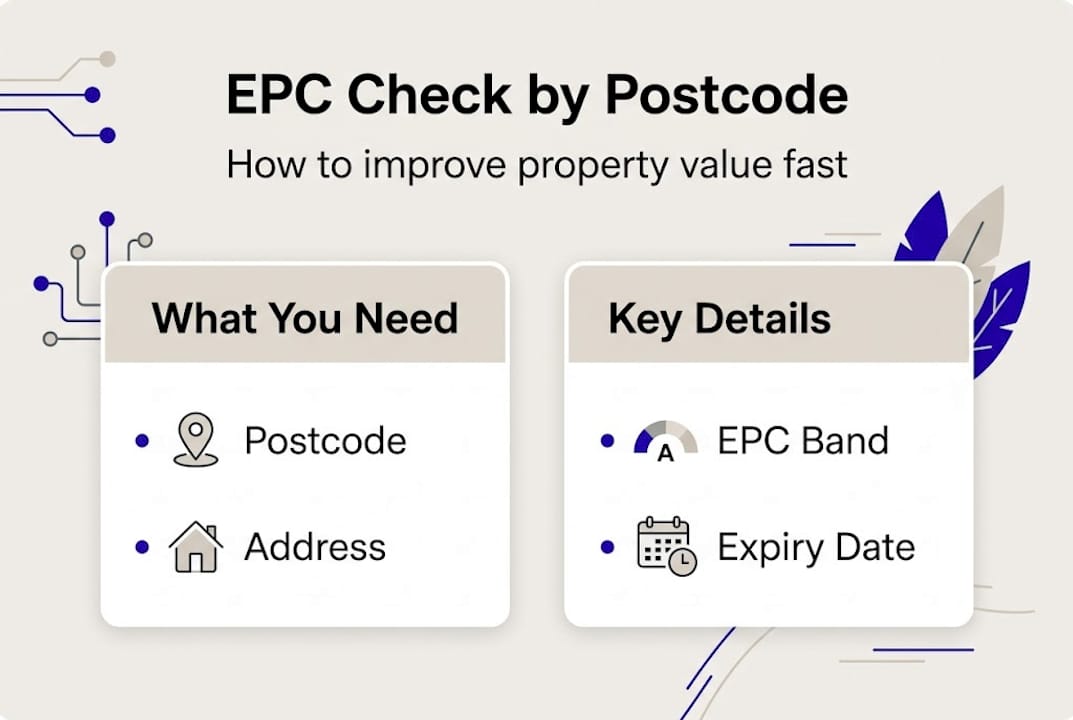
Here is a quick overview of what the EPC register shows you:
| Information displayed | What it means for you |
|---|---|
| EPC band (A to G) | Your current energy efficiency rating |
| Certificate expiry date | Whether your EPC is still legally valid |
| Recommendations list | Suggested improvements and estimated savings |
| Assessor details | Who carried out the assessment and when |
| Potential rating | What your property could achieve with improvements |
Pro Tip: Always search by postcode rather than address alone. The postcode narrows results instantly and reduces the risk of selecting the wrong property, which is a common error in buildings with multiple units.
Step-by-step: How to complete an EPC check by postcode
Now you are ready to carry out your check. Here is what to do, step by step.
-
Go to the GOV.UK EPC register. Open your browser and navigate to the official energy performance certificate search tool. This is the only authoritative source for valid EPC data in England and Wales.
-
Enter your property postcode. Type the full postcode into the search field and press search. The system will return a list of all properties and certificates associated with that postcode.
-
Select the correct address. Review the list carefully. In blocks of flats or converted properties, multiple addresses may appear. Select the exact address that matches your property.
-
Review the certificate details. You will now see the EPC band, the certificate issue date, and the expiry date. EPCs are valid for ten years. Check whether yours is still current.
-
Read the recommendations section. Every EPC includes a list of suggested improvements, from loft insulation to upgrading heating systems. Note the current rating and the potential rating your property could reach.
-
Download the PDF. Save the certificate to your files. This is your legal proof of compliance. Landlords must be able to produce this document on request from a tenant or local authority.
-
Act on the findings. If the certificate is expired or the rating falls below C, you need to either arrange a new assessment or plan upgrades before your next letting.
Using the GOV.UK EPC register and postcode simplifies proof for compliance and planning upgrades toward EPC C or better.
Here is a quick comparison of search methods:
| Search method | Speed | Accuracy risk | Best used when |
|---|---|---|---|
| Postcode only | Very fast | Low | You know the postcode exactly |
| Full address only | Moderate | Medium | Postcode is uncertain |
| Postcode plus address | Fastest and most accurate | Very low | Standard recommended approach |
Pro Tip: If your property does not appear in the search results, it may never have had an EPC or the record may be older than the current database. In both cases, you will need a new assessment before any letting activity.
After the check: Planning upgrades and avoiding common pitfalls
With your certificate in hand, here is how to maximise its value and avoid pitfalls.

Your EPC is more than a compliance document. It is a practical improvement plan. The recommendations section lists specific measures with estimated costs and the impact each one would have on your rating. Start here when planning your upgrade budget.
Upgrading insulation, heating, and ventilation boosts your EPC score and future-proofs against rising standards. In practice, the measures with the highest impact tend to be:
- Cavity wall or solid wall insulation: Often the single biggest contributor to improving an EPC score in older London properties.
- Loft insulation: Relatively low cost with meaningful rating gains, particularly in houses.
- Boiler replacement or heating controls: Upgrading to an A-rated boiler or adding a smart thermostat has a measurable effect on the score.
- Double or triple glazing: Relevant for Victorian properties where single glazing is still common.
- LED lighting throughout: A straightforward improvement that costs little but contributes positively.
“The EPC recommendations section is the most underused tool available to London landlords. Reading it carefully can save thousands in unnecessary works.”
Common mistakes to avoid:
- Missing certificate renewals: An EPC lasts ten years, but if you let the property with an expired certificate, you are in breach of regulations.
- Ignoring older property quirks: Solid wall properties require different insulation solutions than cavity wall builds. A generic upgrade plan will not always apply.
- Waiting for enforcement: Some landlords assume the rules will change or deadlines will shift. Planning proactively is far safer and cheaper than reactive compliance.
- Not updating after improvements: If you complete significant upgrades, arrange a new assessment to reflect the improved rating. Your certificate will not update automatically.
Future standards point toward EPC B or better for commercial properties and continued pressure on residential stock. Planning upgrades in stages now avoids a large single cost as standards rise.
Our view on EPC checks: Why the postcode method is your fastest route to compliance
We have worked with London landlords across all property types, from single-room lets in Zone 3 to large HMOs in central boroughs. One pattern stands out clearly: the landlords who check their EPC status regularly are the ones who adapt fastest when regulations change.
The postcode method is not just convenient. It is strategic. It gives you an instant status check, a downloadable legal document, and a prioritised list of improvements in one place. Landlords who use it proactively discover upgrade opportunities that others miss entirely, particularly when comparing potential ratings against current ratings. That gap represents money left on the table.
There is also a dispute-prevention angle that rarely gets discussed. When a tenant challenges compliance or a local authority requests proof, a downloaded, dated certificate from the official database is far more defensible than a paper copy of uncertain origin. The official database is the definitive record, and accessing it regularly keeps you ahead of any challenge.
Do not treat the postcode check as a one-time task. Build it into your annual property review, and you will never be caught off guard by an expiring certificate or a shifting compliance threshold.
Get expert help with your EPC in London
Ready to streamline your EPC checks and compliance? Here is where to go next.
Knowing your EPC status is the first step, but acting on it efficiently is what separates compliant landlords from those facing fines. At Complete EPC, we provide fast, accurate EPC assessments for London properties at the lowest rates in the UK market. Our qualified assessors understand the specific challenges of London housing stock, from Victorian terraces to modern flats. Explore our EPC assessment process guide to understand exactly what to expect, or visit our Understanding EPCs in London page for a broader overview. For a detailed breakdown of ratings, our EPC rating guide explains every band clearly. Get in touch today and let us handle the compliance so you can focus on your property.
Frequently asked questions
How do I find my property’s EPC using just the postcode?
Use the official GOV.UK EPC Register, enter your postcode, and select your address to instantly access your certificate and download it as legal proof of compliance.
What if my EPC has expired or cannot be found?
You must arrange a new EPC survey with an accredited assessor, as expired certificates do not qualify for legal compliance under current MEES regulations.
Can I upgrade my property’s EPC rating without major renovations?
Minor works like improving lighting or heating controls can boost your rating, but insulation and heating upgrades may be needed to reach the higher bands required from 2026 onward.
Do London landlords need to upgrade to EPC C for existing tenants in 2026?
From 2026, new lettings require EPC C; existing tenancies are currently expected to need compliance by 2028, so planning upgrades now puts you well ahead of both deadlines.