

TL;DR:
- EPC letting requirements in London set minimum energy efficiency standards, rising from band E to band C by 2030. Landlords must register exemptions, improve properties, and update certificates to avoid fines up to £30,000. Acting early on assessments and upgrades helps maintain compliance and increases property value.
EPC letting requirements are the legal rules that determine the minimum energy efficiency standard a rental property must meet before a landlord can legally let it. The current minimum is band E under the Minimum Energy Efficiency Standards (MEES) regulations, and F or G-rated properties cannot be let without a registered exemption. That threshold rises to band C by 1 october 2030, with fines reaching £30,000 for non-compliance. If you manage or own rental property in London, understanding these obligations now gives you time to plan upgrades, register exemptions where valid, and protect your income.
What are the EPC letting requirements for landlords?
EPC letting requirements set the legal baseline every private landlord in England must meet before granting a tenancy. The Minimum Energy Efficiency Standards regulations, introduced under the Energy Act 2011 and enforced by local authorities, make it unlawful to let a residential property with an EPC rating below band E. This applies to new tenancies and renewals alike.

The Department for Energy Security and Net Zero oversees the policy framework behind these standards. Local councils carry out enforcement on the ground, and they hold real powers. Fines currently reach £5,000, and under upcoming rules that figure rises to £30,000. That is not a theoretical risk for London landlords. The capital’s housing stock includes a significant proportion of older, poorly insulated properties that sit close to or below the legal threshold.
The EPC itself is a standardised document produced by an accredited domestic energy assessor. It rates a property on a scale from A (most efficient) to G (least efficient) and includes a list of recommended improvements. You must provide a valid EPC to prospective tenants before a tenancy begins. Failing to do so is a separate offence from failing to meet the minimum rating.
How do MEES regulations affect letting practices?
The MEES regulations create a direct legal barrier between a substandard property and a paying tenant. Properties rated F or G cannot be let under any new or continuing tenancy unless a valid exemption is registered on the PRS Exemptions Register. This is not a grace period. It is an immediate prohibition.
The practical implications for tenancy agreements are significant:
- You cannot start a new tenancy on a property below band E without a registered exemption.
- Existing tenancies on substandard properties became subject to MEES from april 2020.
- A valid EPC must be in place before marketing a property to new tenants.
- Landlords cannot charge tenants for the cost of obtaining an EPC.
- Local authorities can issue compliance notices and impose civil penalties without warning.
The financial exposure is real and growing. Current penalties sit at up to £5,000 per property. The government has confirmed that fines will increase to £30,000 under the forthcoming enforcement regime tied to the 2030 deadline. For a London landlord with a portfolio of older Victorian terraces, the cumulative risk is material.
Pro Tip: Keep a compliance log for each property showing the EPC rating, certificate expiry date, and any exemption registration reference. Local authorities can request this evidence at any time, and having it ready prevents delays.
What does the EPC certification process involve?
Obtaining an EPC is a straightforward process, but landlords need to understand what it covers and when it must be renewed. An EPC assessment costs between £60 and £120 and involves an on-site visit lasting 45–90 minutes. The assessor is accredited and works to a standardised methodology set by the government.
The assessor examines the following elements during the visit:
- Wall construction and insulation — cavity, solid, or insulated, each scored differently.
- Roof and loft insulation — thickness and material affect the rating significantly.
- Windows and glazing — single, double, or triple glazing, plus frame type.
- Heating system — boiler type, age, controls, and fuel source.
- Hot water system — cylinder insulation and heating method.
- Lighting — proportion of low-energy fittings throughout the property.
The resulting certificate is valid for 10 years. You do not need a new one simply because a tenant changes, provided the existing certificate has not expired. A new EPC is required when the certificate expires, when you market the property to new tenants after expiry, or when you carry out improvements and want the rating updated. You can follow the full EPC assessment process for London properties if you want a step-by-step breakdown before booking.
For houses in multiple occupation (HMOs) and shared buildings, the rules differ slightly. Landlords often need only a single EPC covering the whole building rather than individual certificates for each let room, though this depends on the tenancy structure and how the building is divided.
Pro Tip: If you have recently installed a new boiler or added loft insulation, commission a new EPC before your next tenancy. An updated rating could move you from band D to band C, keeping you ahead of the 2030 deadline at no additional upgrade cost.
When can landlords use the PRS Exemptions Register?
The PRS Exemptions Register is the official government database where landlords record valid reasons for letting a property below the minimum EPC band. Registering an exemption is not optional. Landlords must register before relying on an exemption to continue letting a substandard property. The exemption is legally binding from the date of registration, not from the date the problem was identified.
The main categories of exemption are:
- High cost exemption — all relevant improvements would cost more than £3,500 (including VAT). You must provide at least three contractor quotes as evidence.
- All improvements made — you have installed every recommended measure but the property still falls below band E.
- Third-party consent refused — a tenant, freeholder, or planning authority has refused permission for the required works.
- Devaluation exemption — a surveyor confirms in writing that the improvements would reduce the property’s market value by more than 5%.
- New landlord exemption — a six-month temporary exemption applies when you acquire a property through inheritance or repossession.
| Exemption type | Evidence required |
|---|---|
| High cost | Three independent contractor quotes showing total cost exceeds £3,500 |
| All improvements made | Invoices and EPC confirming measures installed but rating still below band E |
| Consent refused | Written refusal from tenant, freeholder, or planning authority |
| Devaluation | Written report from a qualified surveyor |
| New landlord | Documentation confirming acquisition date and circumstances |
Maintaining a thorough exemption file with all supporting documents is critical. Local authority audits do happen, and an exemption without proper evidence is treated as no exemption at all. You can find detailed guidance on EPC exemption registration to understand exactly what documents each category requires.
What are the upcoming EPC changes and the 2030 deadline?
The most significant shift in EPC requirements for landlords is the confirmed move to band C as the minimum standard. The minimum EPC rating for private rentals rises to band C by 1 october 2030, applying to all tenancies, both new and existing. The government abandoned an earlier phased rollout in favour of a single unified deadline. Every private rented property in England must meet band C by that date or have a valid registered exemption.
The financial implications are considerable:
- The spending cap for required improvements is expected to rise to £10,000 per property under the new regime.
- Properties where all cost-effective measures still leave the rating below band C may qualify for the high-cost exemption at the £3,500 threshold under current rules, though this figure may be revised.
- Non-compliance fines will reach £30,000 per property.
- Landlords who act early can spread upgrade costs across multiple tax years and avoid last-minute contractor shortages.
Beyond the letter grade, the government is also planning a broader reform of how EPCs measure performance. Future EPC metrics will shift from a single letter grade toward separate scores covering energy cost, fabric performance, heating system type, and smart readiness. This means the letter grade you achieve today may be assessed differently under the new framework. Landlords who focus on improving the physical fabric of their properties, such as insulation and glazing, will be better placed regardless of how the metrics evolve.
The government’s direction is clear. Waiting until 2029 to assess your portfolio is a high-risk strategy. Contractor availability, material costs, and planning lead times all increase as deadlines approach. London landlords with older stock should treat 2026 and 2027 as the planning window, not 2029.
Practical steps to meet EPC requirements in London
Meeting EPC requirements is a property management task, not just a compliance exercise. Landlords who treat it as an asset management decision consistently get better outcomes. Improving a property’s EPC rating by one band can increase its market value by 1–3%. That is a measurable return on the cost of insulation or a heating upgrade.
The most cost-effective improvements for London properties typically follow this order:
- Loft insulation — low cost, high impact on rating, minimal disruption to tenants.
- Cavity wall insulation — applicable to most post-1920 London terraces and semi-detached properties.
- Boiler replacement — upgrading from an old G-rated boiler to an A-rated condensing model delivers significant rating gains.
- Double glazing — replacing single-glazed sash windows in period properties is expensive but often necessary for band C.
- Smart heating controls — thermostatic radiator valves and programmable thermostats are low cost and improve the heating score.
Use the recommendations section of your existing EPC as your starting point. Each recommendation includes an estimated cost range and the potential rating improvement. This makes it straightforward to prioritise by return on investment rather than guessing which upgrades matter most.
Pro Tip: Commission your EPC assessment before starting any upgrade work. The assessor’s recommendations will tell you exactly which measures will move your rating and by how much. Spending money on improvements that do not affect the rating is a common and avoidable mistake.
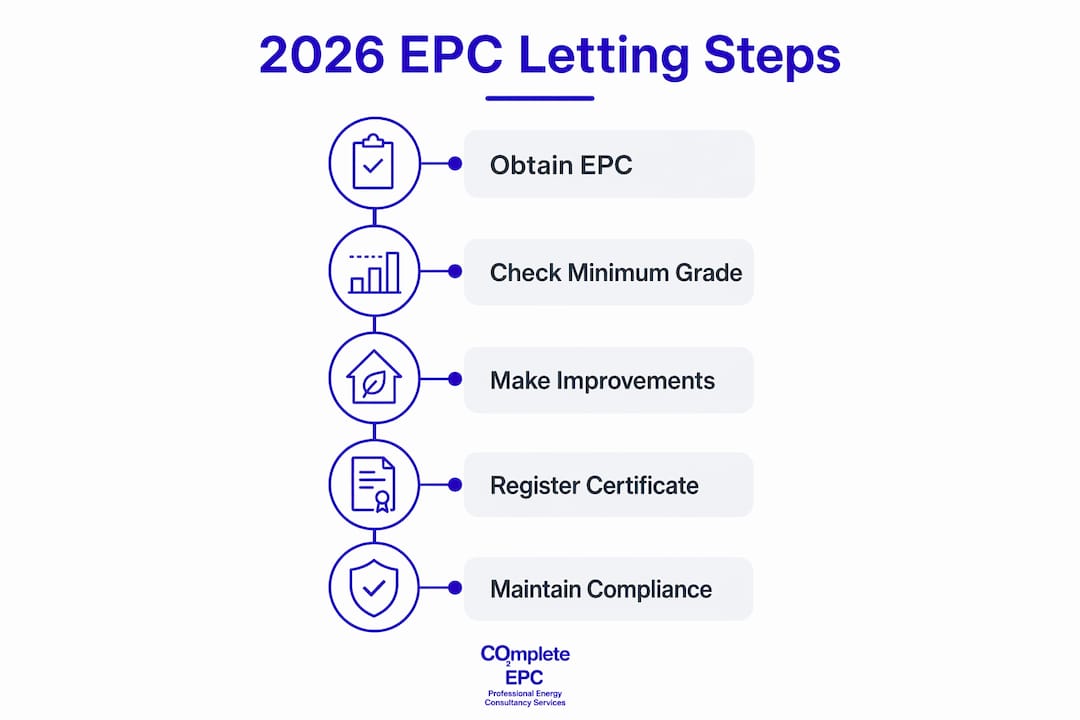
Landlords should also maintain a renewal schedule. Track the expiry date of every EPC in your portfolio and set a reminder 12 months before expiry. This gives you time to book an assessment, act on recommendations, and have the new certificate in place before marketing the property. The EPC renewal process is well documented and straightforward when planned in advance.
Key takeaways
EPC letting requirements in London demand that every rental property holds a valid certificate at band E or above now, rising to band C by 1 october 2030, with fines of up to £30,000 for non-compliance.
| Point | Details |
|---|---|
| Current minimum standard | Band E is the legal minimum; F and G-rated properties cannot be let without a registered exemption. |
| 2030 deadline | All private rented properties must reach band C by 1 october 2030 or face fines up to £30,000. |
| EPC validity | Certificates last 10 years; renew when expired, when marketing to new tenants, or after improvements. |
| Exemptions require registration | Register on the PRS Exemptions Register before relying on any exemption, with full documentary evidence. |
| Upgrades add value | Improving a property by one EPC band can increase its market value by 1–3%. |
Why I think most London landlords are underestimating the 2030 deadline
Working in the London property market, I see the same pattern repeatedly. Landlords acknowledge the 2030 band C requirement, note that it is four years away, and then do nothing. That is a mistake that will cost them significantly more than acting now.
The practical reality is that London’s older housing stock, Victorian terraces, Edwardian flats, and interwar semis, often requires multiple interventions to reach band C. Loft insulation alone will not get a solid-walled period property from band E to band C. You may need external or internal wall insulation, new glazing, and a boiler replacement. Each of those requires planning, contractor availability, and in some cases listed building consent or freeholder approval. None of that happens quickly.
The landlords I see handling this well are treating EPC compliance as part of their five-year asset plan. They are commissioning assessments now, identifying the gap between their current rating and band C, and scheduling works during void periods to minimise disruption and cost. They are also benefiting from the energy cost savings that come with better-insulated properties, which makes them more attractive to tenants and reduces maintenance calls in winter.
My honest view is that the government’s shift toward more detailed performance metrics, covering fabric, heating, and smart readiness, makes the underlying building quality more important than chasing a letter grade. Landlords who invest in real fabric improvements will be compliant under any future metric system. Those who look for shortcuts may find their properties fall short again when the new framework arrives.
— Danny
How Completeepc helps London landlords stay compliant
Completeepc provides domestic EPC assessments for landlords and property managers across London, carried out by fully accredited assessors with direct experience of the capital’s varied housing stock. Whether you need a certificate for a new tenancy, an updated rating after improvements, or guidance on where your property sits relative to the 2030 band C deadline, Completeepc delivers accurate assessments at competitive rates. The service covers the full EPC compliance workflow from initial assessment through to certificate issuance, with clear advice on next steps if your property needs to improve its rating. Booking is straightforward, turnaround is fast, and every certificate is lodged on the national register.
FAQ
What is the minimum EPC rating to let a property in 2026?
The legal minimum EPC rating for private rental properties in England is band E. Properties rated F or G cannot be let without a valid exemption registered on the PRS Exemptions Register.
When does the EPC minimum rise to band C?
The minimum EPC rating for all private rented properties rises to band C by 1 october 2030. This applies to both new and existing tenancies, with no phased rollout.
How long is an EPC valid for?
An EPC is valid for 10 years from the date of issue. A new certificate is required when the existing one expires, when marketing to new tenants after expiry, or when improvements have been made and you want the rating updated.
What happens if a landlord does not comply with EPC requirements?
Local authorities can currently fine landlords up to £5,000 per property for non-compliance. Under the enforcement rules tied to the 2030 deadline, that fine increases to £30,000.
Do HMOs need a separate EPC for each room?
In most cases, a single EPC covering the whole building is sufficient for an HMO. However, requirements can vary depending on the tenancy structure and how the building is divided, so it is worth confirming with an accredited assessor.