

TL;DR:
- Landlords must obtain a valid EPC before selling or renting properties to avoid fines up to £30,000.
- Booking an EPC assessment involves preparing property details, ensuring access, and choosing accredited assessors.
- EPCs provide energy ratings and improvement suggestions, but may require updates as regulations and methods evolve.
Failing to hold a valid Energy Performance Certificate (EPC) is not a minor oversight. Landlords and property owners in London can face fines up to £30,000 for non-compliance, and without one, you cannot legally sell, rent, or lease a property. The good news is that booking an EPC assessment is far more straightforward than most people expect. This guide walks you through everything: what an EPC is, how to prepare, what happens on the day, and how to act on your results to stay fully compliant in 2026.
Table of Contents
- What is an EPC and why do you need one?
- What you need to book an EPC assessment
- Step-by-step: How to book your EPC in London
- Understanding your EPC results and ensuring compliance
- A fresh perspective: The practical limits and future of EPCs
- Ready to book your EPC? Start here
- Frequently asked questions
Key Takeaways
| Point | Details |
|---|---|
| Minimum legal rating | You need an EPC rating of at least E to legally rent property in London. |
| Booking steps | Booking an EPC involves preparing access, selecting an accredited assessor, and reviewing your results. |
| Modelled not measured | EPC grades predict likely annual energy use and may not match your actual bills. |
| Future-ready | New government reforms will make EPCs more accurate for innovative properties by 2027. |
What is an EPC and why do you need one?
An Energy Performance Certificate is an official document that rates a property’s energy efficiency on a scale from A (most efficient) to G (least efficient). It tells buyers and tenants how costly a property is to run and what improvements could reduce those costs. Every EPC includes two ratings: one for energy efficiency and one for environmental impact.
In practical terms, an EPC is a legal requirement. If you are selling, letting, or leasing a property, you must have a valid certificate in place before marketing begins. Under the current Minimum Energy Efficiency Standards (MEES), rental properties must achieve at least an ‘E’ rating. Falling below this threshold means you cannot legally grant a new tenancy.
Here is a quick summary of which properties in London require an EPC:
- Residential properties being sold or rented
- Commercial premises being sold, let, or leased
- New builds completed after 2008
- Properties that have undergone significant modification
The financial consequences of ignoring this requirement are serious. Beyond fines, an invalid or missing EPC can delay or collapse a property sale, expose you to tenant disputes, and damage your professional reputation. For landlords managing multiple properties across London, even one lapse can trigger enforcement action from your local authority.
It is also worth knowing that EPCs are valid for ten years. If your certificate has expired and you intend to sell or re-let, you need a fresh assessment before proceeding.
Key fact: In 2026, the government continues to enforce MEES regulations, with further tightening expected in coming years. Staying ahead now protects you from future disruption.
What you need to book an EPC assessment
Preparing properly before you book makes the entire process faster and less stressful. Assessors need accurate information about your property, so gathering a few key details in advance saves time on both sides.
For the booking itself, you will need:
- The full property address and postcode
- Your contact details and preferred appointment time
- Any previous EPC reference number, if one exists
- Basic details about the property type (flat, terraced house, office, warehouse, etc.)
On the day of the assessment, your assessor will need physical access to every room, the boiler or heating system, the loft or roof space, and any outbuildings that form part of the property. Blocked access can result in assumptions that lower your rating, so clearing the way beforehand is worthwhile.

Finding the right assessor matters too. Always choose someone who is accredited with an approved body such as Elmhurst Energy or ECMK. You can verify credentials through the national EPC register.
Pro Tip: Ask your assessor whether they use RdSAP (Reduced Data SAP) for residential properties or SBEM/NCM for commercial ones. Domestic EPCs use RdSAP while commercial assessments use different methodology, and knowing which applies to your property helps you understand the scope of the visit.
| Property type | Methodology used | Typical assessment time |
|---|---|---|
| Residential (flat, house) | RdSAP | 30 to 60 minutes |
| Small commercial unit | SBEM/NCM | 1 to 2 hours |
| Large commercial building | SBEM/NCM | 2 to 4+ hours |
| New build residential | Full SAP | 45 to 90 minutes |
Always confirm your assessor’s accreditation before paying any deposit. A qualified professional will be happy to provide their registration number.
Step-by-step: How to book your EPC in London
Once you are ready to book, follow these steps for a smooth, compliant process.
- Identify the correct assessment type. Decide whether you need a domestic or commercial EPC. The process, cost, and methodology differ between the two.
- Search for an accredited assessor. Look for assessors who are registered with an approved scheme. Check online reviews and confirm their credentials before making contact.
- Request a quote. Prices vary by property size and type. Get at least two quotes to ensure you are paying a fair rate.
- Confirm the booking. Provide your property address, a point of contact for access, and any specific access instructions. Agree on a date and time that works for both parties.
- Prepare the property. Ensure all rooms, cupboards, the loft hatch, and the boiler are accessible. Gather any relevant documents such as building certificates or planning permissions for recent works.
- Attend the assessment or arrange access. The assessor will visit on-site and enter data into approved EPC software. They will check insulation levels, glazing type, heating systems, lighting, and renewable energy installations.
- Receive your certificate. The EPC is lodged on the national register, usually within 24 to 48 hours. You will receive a copy along with an advisory report showing recommended improvements.
Pro Tip: For commercial properties in London, the assessment process tends to be more involved. Make sure your facilities manager or building contact is available on the day to provide access to plant rooms and mechanical systems.
| Feature assessed | Residential | Commercial |
|---|---|---|
| Heating system | Yes | Yes |
| Insulation (walls, roof, floor) | Yes | Yes |
| Glazing type | Yes | Yes |
| Lighting efficiency | Partial | Full assessment |
| Renewables (solar, heat pump) | Yes | Yes |
| Air conditioning systems | No | Yes |
Understanding your EPC results and ensuring compliance
With your certificate in hand, understanding what those results mean is your final step to full compliance.
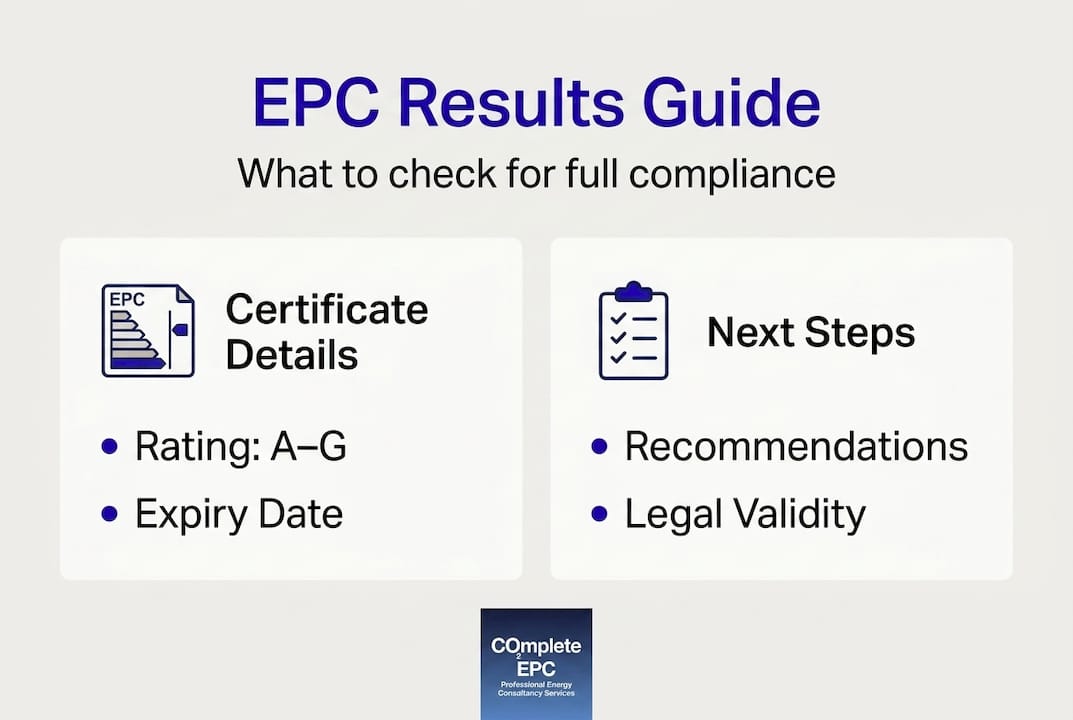
Your EPC will show a current energy rating and a potential rating if all recommended improvements are made. It will also include an estimate of annual energy costs and a list of suggested upgrades, ranked by impact and cost-effectiveness.
Here is what to look for when reviewing your report:
- Current rating: Where your property sits now on the A to G scale
- Potential rating: Where it could reach with recommended improvements
- Recommendations: Specific actions such as adding loft insulation, upgrading the boiler, or installing double glazing
- Validity period: The date the EPC expires (ten years from issue)
If your property scores below an E and you are letting it out, you must act. You can carry out the recommended improvements and commission a new assessment, or investigate whether an exemption applies. Valid exemptions include cases where improvements would damage the property or cannot be financed under a certain cost cap.
“EPCs are modelled ratings based on expected annual energy use, not actual consumption” which means your real bills may differ from the figures shown. This is important context when using EPC data to make investment decisions.
One of the most common mistakes landlords make is ignoring the recommendations section entirely. Even if your property already meets the minimum E rating, acting on those suggestions can reduce tenant energy costs, increase property appeal, and strengthen your position ahead of future regulatory tightening.
Another frequent error is letting an EPC expire without realising it. If you have been renting out a property for nearly ten years, check your certificate’s issue date now.
A fresh perspective: The practical limits and future of EPCs
Now that you know the full process, here is what most guides do not tell you about the real-world value and future of EPCs.
EPCs serve an important regulatory function, but they are not a perfect measure of a property’s true energy performance. The current RdSAP methodology relies on standardised assumptions rather than bespoke property data. This means that innovative features such as high-performance mechanical ventilation or specialist insulation systems can be misrepresented by RdSAP, sometimes resulting in a lower rating than the property genuinely deserves.
The government is aware of these limitations. Planned upgrades to the Home Energy Model (HEM) aim to introduce more dynamic, property-specific calculations that better reflect real-world conditions. For London property owners, this signals change ahead. Ratings that appear solid today may shift when the new methodology is applied.
Our advice is straightforward: treat compliance as the baseline, not the goal. Use your EPC recommendations as a genuine starting point for efficiency improvements, rather than a box-ticking exercise. Properties that perform well in practice, not just on paper, are better insulated against regulatory change and more attractive to quality tenants. The landlords who will be best placed in the coming years are those who invest in real improvements now, ahead of the next wave of regulation.
Ready to book your EPC? Start here
If you are looking for expert support or need to ensure full compliance with the latest regulations, Complete EPC is here to help. Our qualified assessors cover all of London, offering competitive rates and a fast, reliable service for both residential and commercial properties. Whether you are preparing for a sale, arranging a new tenancy, or simply updating an expired certificate, we make the process straightforward.
Explore our EPCs in London guide to understand your requirements, review the full EPC assessment process step by step, or check our EPC legal compliance workflow to confirm you are meeting every obligation. Get in touch today and we will match you with the right accredited assessor for your property.
Frequently asked questions
How long does an EPC assessment take in London?
Residential EPCs typically take 30 to 60 minutes, while commercial assessments can take from one to four hours or more, depending on the size and complexity of the building.
What happens if my property fails to achieve an E rating?
You must make improvements or check if you are eligible for an exemption. Properties that do not meet the minimum standard can face fines up to £30,000 under MEES enforcement.
Are EPCs based on actual energy use?
No. EPCs use modelled calculations based on property features such as insulation, glazing, and heating type, rather than your actual energy bills or consumption history.
How often do I need to renew my EPC?
Your EPC is valid for 10 years from the date of issue. After that, you must obtain a new one if you plan to sell, rent, or lease the property.