

TL;DR:
- SAP is the UK’s official method for measuring residential energy performance, critical for compliance.
- Accurate early-stage SAP assessments help avoid costly redesigns and delays in London property projects.
- Improving building fabric first and ensuring proper documentation boost SAP scores and property value.
Failing an energy compliance check mid-transaction can cost you far more than time. SAP is mandatory for London property compliance, and getting it wrong can trigger forced redesigns, delayed completions, and penalties reaching £5,000 or more. Whether you are a landlord preparing for tighter 2030 standards, an estate agent managing a new build sale, or a property owner navigating Part L Building Regulations, understanding how SAP calculations work is no longer optional. This guide walks you through what SAP is, how the process works, what affects your score, and the mistakes you must avoid to pass first time.
Table of Contents
- What is SAP and why does it matter in London?
- The SAP calculation process: Step-by-step for London properties
- Understanding the numbers: What affects your SAP score
- Compliance tips and common SAP mistakes in London
- Why accuracy in SAP calculations matters more than ever
- Get expert help navigating SAP compliance in London
- Frequently asked questions
Key Takeaways
| Point | Details |
|---|---|
| SAP is legally required | Every property sale or let in London needs a SAP-based EPC for compliance. |
| Start SAP assessments early | Engage an accredited assessor at the design stage to avoid costly mistakes and delays. |
| Fabric-first approach wins | Prioritise insulation, airtightness, and building fabric to maximise SAP scores cost-effectively. |
| Common pitfalls cost time | Late SAP calculations, overlooked details, and ignoring benchmarks can lead to delays and fines. |
| Ratings boost property value | Higher EPC bands in London can mean significant gains in property resale or rental value. |
What is SAP and why does it matter in London?
SAP stands for Standard Assessment Procedure. It is the UK government’s official method for measuring the energy performance of residential dwellings, producing scores on a scale from 1 to 100 and above. The higher the score, the more energy-efficient the property. Those scores then translate directly into the EPC ratings you see labelled A through to G.
Here is how SAP scores map to EPC bands:
| SAP score | EPC band |
|---|---|
| 92 and above | A |
| 81 to 91 | B |
| 69 to 80 | C |
| 55 to 68 | D |
| 39 to 54 | E |
| 21 to 38 | F |
| 1 to 20 | G |
In London, SAP is not just a technical formality. It sits at the heart of Part L Building Regulations compliance for new residential construction. Without a valid SAP calculation, you cannot obtain building control sign-off, which means you cannot legally complete a sale or let the property.
For landlords, the stakes are equally real. Properties rated F or G cannot be legally let under current Minimum Energy Efficiency Standards (MEES). The London rental market is competitive, and a poor EPC rating does not just create a compliance problem. It actively reduces the pool of tenants willing to pay your asking rent.
Key reasons SAP matters for London property owners:
- New builds require SAP at both design stage and completion to satisfy building control
- Rental properties must meet EPC E as a minimum today, with C required by 2030
- Sales transactions require a valid EPC, which is generated from SAP data
- Higher-rated properties command measurable value premiums in London’s competitive market
- Planning applications in some London boroughs now reference energy performance as part of sustainability assessments
Properties rated B or above consistently attract faster sales and lower void periods. That is a direct financial argument for investing in accurate SAP work from the outset.
The SAP calculation process: Step-by-step for London properties
Understanding the process removes most of the uncertainty. There are two main types of SAP assessment, and knowing which one applies to your property is the starting point.
Design-stage and as-built SAP calculations are required for new construction, while RdSAP (Reduced data SAP) is used for existing dwellings where a full set of plans is not available. Here is a quick comparison:
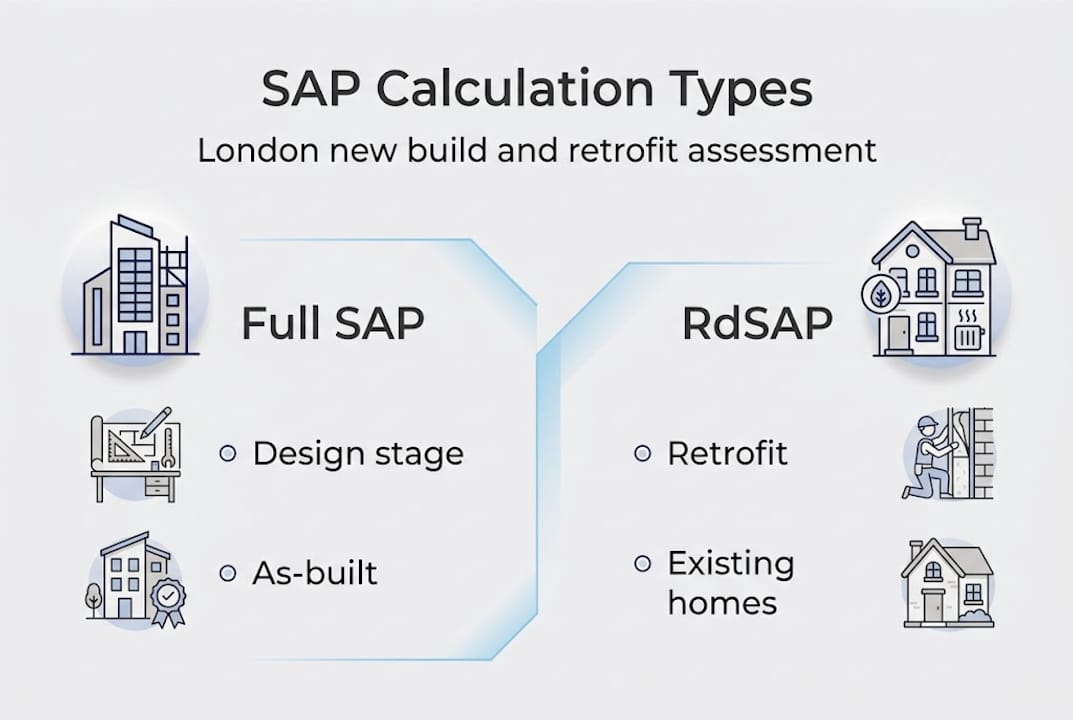
| Assessment type | Used for | Data required |
|---|---|---|
| Full SAP | New builds and major extensions | Architectural plans, specs, U-values, heating design |
| RdSAP | Existing homes | On-site survey, visible construction details, meter data |
For new builds, you will need two separate SAP reports: one at design stage (to confirm the building will comply before work begins) and one at completion (to confirm it was built as designed).
Here is the step-by-step process for getting a compliant SAP calculation:
- Appoint a qualified assessor early. Bring your assessor in at design stage, not after the build is finished. Changes on paper cost far less than changes on site.
- Gather your documents. For new builds, this means floor plans, elevations, construction specifications, U-value calculations, and heating system details. For existing properties, gather any records of past upgrades, boiler specifications, and insulation details.
- Brief the assessor thoroughly. Share all relevant design decisions, including window specifications, ventilation strategy, and any renewable energy systems planned.
- The assessor runs the SAP calculation. Using accredited software, they model the property’s energy performance against the required benchmarks.
- Review the report. Check that the outputs reflect your design intent. If the score falls short, this is the point to adjust specifications rather than after construction.
- Submit to building control. For new builds, the design-stage SAP is submitted with your building regulations application. The as-built report follows at completion.
Pro Tip: Ask your assessor to model two or three specification options at design stage. Comparing the SAP impact of different insulation or heating choices costs very little at this point and can save thousands later.
Understanding the numbers: What affects your SAP score
Once the process starts, it pays to know which design or upgrade choices move the needle most. SAP is not a single measurement. It is a modelled outcome built from multiple inputs, and factors include U-values, airtightness, thermal bridging, and heating, with fabric-first improvements consistently outperforming single-system upgrades.
Here is what each factor means in practice:
- U-values measure how quickly heat escapes through walls, roofs, and floors. Lower U-values mean better insulation and a higher SAP score.
- Airtightness refers to how well sealed the building is against uncontrolled air leakage. Draughty properties lose significant heat and score poorly.
- Thermal bridging occurs where materials with different insulating properties meet, such as at window frames or floor junctions. Poorly detailed junctions can undermine an otherwise well-insulated building.
- Heating system efficiency covers boiler type, controls, and distribution. A modern heat pump scores significantly better than an old gas boiler under current SAP methodology.
- Renewable energy such as solar photovoltaic panels can add points directly to your SAP score.
- Lighting and ventilation also contribute, though typically to a lesser degree than the fabric and heating choices.
The fabric-first approach means prioritising the building envelope before adding technology. Insulate well, seal thoroughly, and detail junctions carefully. Only then consider upgrading heating or adding renewables. This order of priority tends to produce the most cost-effective improvements because it reduces the energy demand that any heating system has to meet.
One figure worth knowing: the gap between a modelled SAP score and real-world energy bills is typically 20 to 40 per cent. This is known as the performance gap, and it occurs when construction does not match the specification. Good site supervision and post-build testing close this gap considerably.

Pro Tip: Commission an air pressure test (also called a blower door test) after construction. It confirms your airtightness figure and protects your as-built SAP result if the tested figure is better than the design assumption.
Compliance tips and common SAP mistakes in London
London landlords and developers face a clear compliance timeline. Landlords must meet EPC E or better now, with EPC C required by 2030, and failure can mean fines or delays, with London boroughs actively enforcing via licensing schemes.
Here are the steps that keep you on the right side of those requirements:
- Check your current EPC rating. If it is F or G, you cannot legally let the property. If it is D or E, plan your upgrade path to C now, before 2030 pressure builds.
- Appoint an accredited assessor. Only assessors on an approved accreditation scheme can produce valid SAP reports for building control or EPC purposes.
- Document every upgrade. Insulation installed, boilers replaced, and windows upgraded all affect your SAP score, but only if the assessor can verify them with evidence.
- Communicate design changes promptly. If specifications change during construction, inform your assessor immediately. An as-built SAP based on outdated plans will not reflect the actual property.
- Plan for re-assessment after major works. Significant improvements should trigger a new EPC to reflect the updated rating.
Leaving SAP to the final stages of a project is one of the most expensive mistakes a London developer can make. By that point, the options for improving a failing score are limited to costly physical changes rather than straightforward specification adjustments.
Common mistakes to avoid:
- Commissioning SAP only at completion rather than at design stage
- Using unverified or assumed upgrade figures rather than certified product data
- Ignoring thermal bridging details in favour of headline insulation values
- Assuming a previous EPC is still valid after significant works
Pro Tip: Keep a compliance folder for each property containing the SAP report, EPC certificate, installer certificates, and product data sheets. If a London borough licensing officer requests evidence, you can respond immediately without scrambling for paperwork.
Why accuracy in SAP calculations matters more than ever
Many property owners treat SAP as a box-ticking exercise. That approach is becoming increasingly costly. The Home Energy Model is replacing SAP from 2025 onwards, designed to produce sharper, more accurate assessments that better reflect real-world performance, and modelled SAP scores can already diverge from actual energy bills by 20 to 40 per cent.
The shift to the Home Energy Model raises the bar significantly. Properties that scraped through under SAP may not fare as well under the new methodology. Owners who relied on marginal compliance will find themselves facing reassessment costs and potentially forced improvements.
Our view is straightforward: the cheapest errors to fix are always the ones caught on paper. An assessor involved at design stage, working within a fabric-first framework, gives you the best chance of a strong score at the lowest cost. Properties with ratings of B or above are not just compliant. They attract better tenants, sell faster, and carry measurable value premiums in London’s market.
The regulatory direction is clear. Standards are tightening, enforcement is increasing, and the financial consequences of non-compliance are growing. Treating SAP accuracy as a genuine business priority rather than a compliance afterthought is the most practical position any London property professional can take right now.
Get expert help navigating SAP compliance in London
Getting SAP right the first time saves you money, protects your property value, and keeps transactions moving. At Complete EPC, our accredited assessors work with London property owners, landlords, and developers at every stage, from initial design through to as-built certification. Whether you need to understand the difference between SAP and EPC in our EPC vs SAP guide, follow the full London EPC process, or get a thorough explanation of SAP calculations explained, we have the resources and expertise to support you. Reach out today and take the uncertainty out of your next compliance step.
Frequently asked questions
What do I need to prepare before a SAP calculation in London?
For new builds, you will need detailed plans, construction specifications, insulation data, and heating system details. For existing homes, SAP uses on-site assumptions alongside any available upgrade records and survey access.
How long does a SAP calculation take?
Most SAP assessments are completed within a few days to a week, depending on the size of the project and how quickly full documentation is provided to the assessor.
Can I improve my property’s SAP score after assessment?
Yes. Upgrading insulation, heating systems, or glazing will improve your score, but the greatest gains come from fabric-first improvements planned and implemented before construction is complete.
What is the difference between SAP and EPC?
SAP is the calculation methodology, while the EPC is the certificate it produces. SAP methodology produces the A to G rating used for legal compliance in sales, lettings, and building control.
Do London properties need to meet higher SAP and EPC standards?
Yes. EPC C is required by London landlords by 2030, and new builds are typically expected to achieve band B or above, reflecting the capital’s stronger focus on energy performance.