

Many british property owners in Greater London mistakenly believe an Energy Performance Certificate assessment is just a box-ticking exercise, yet penalties for non-compliance can reach £5,000. Today’s rental and sales markets demand more than basic paperwork. Reliable, accredited EPC assessors deliver technical insight that supports legal compliance, reduces running costs, and protects property value—giving landlords the informed edge when it matters most.
Table of Contents
- Defining EPC Assessors And Common Misconceptions
- Types Of EPC Assessors And Core Qualifications
- How The EPC Assessment Process Works
- Legal Requirements And Regulatory Obligations
- Financial Impact And Mistakes To Avoid
Key Takeaways
| Point | Details |
|---|---|
| Role of EPC Assessors | EPC assessors conduct detailed evaluations of properties’ energy performance, going beyond mere inspections to provide actionable insights for compliance and efficiency improvements. |
| Types of Assessors | There are two main types: Domestic Energy Assessors (DEAs) for residential properties and Non-Domestic Energy Assessors (NDEAs) for commercial buildings. |
| Legal Obligations | Properties must have a valid Energy Performance Certificate (EPC) to be sold or rented, with significant penalties for non-compliance. |
| Financial Implications | Poor EPC ratings can lead to substantial financial losses, including reduced property value and increased utility costs, making proactive energy improvements essential. |
Defining EPC Assessors and Common Misconceptions
EPC assessors are specialised professionals who play a critical role in evaluating the energy performance of properties across London. These trained experts conduct comprehensive assessments that provide property owners with detailed insights into their building’s energy efficiency, enabling them to understand potential improvements and meet legal compliance requirements. Qualified energy assessors in London have specific responsibilities that go far beyond a simple inspection.
Typically, an EPC assessor will perform a systematic evaluation of a property’s thermal characteristics, including insulation quality, heating systems, lighting efficiency, and overall energy consumption patterns. Their assessment involves measuring key performance indicators such as heat loss, thermal bridging, and potential energy-saving opportunities. Unlike popular misconceptions, these professionals are not simply walking through a property with a checklist, but are conducting a highly technical and precise examination that requires specialised training and certification.
Many London property owners mistakenly believe that EPC assessments are quick, superficial processes. In reality, these assessments involve complex calculations using standardised methodologies that consider multiple factors like building fabric, construction materials, heating systems, and potential renewable energy integrations. Understanding EPC requirements is crucial for property owners who want to navigate the increasingly strict energy efficiency regulations in the United Kingdom.
Pro Tip: Always verify an EPC assessor’s accreditation and ask to see their professional credentials before scheduling an assessment to ensure you receive a comprehensive and legally compliant energy performance evaluation.
Types of EPC Assessors and Core Qualifications
In the United Kingdom, EPC assessors are categorised into two primary types: Domestic Energy Assessors (DEAs) and Non-Domestic Energy Assessors (NDEAs). Domestic assessors specialise in residential properties, including houses, flats, and apartments, while non-domestic assessors focus on commercial, industrial, and public sector buildings. Assessor qualification standards are rigorously defined to ensure comprehensive and accurate energy performance evaluations.
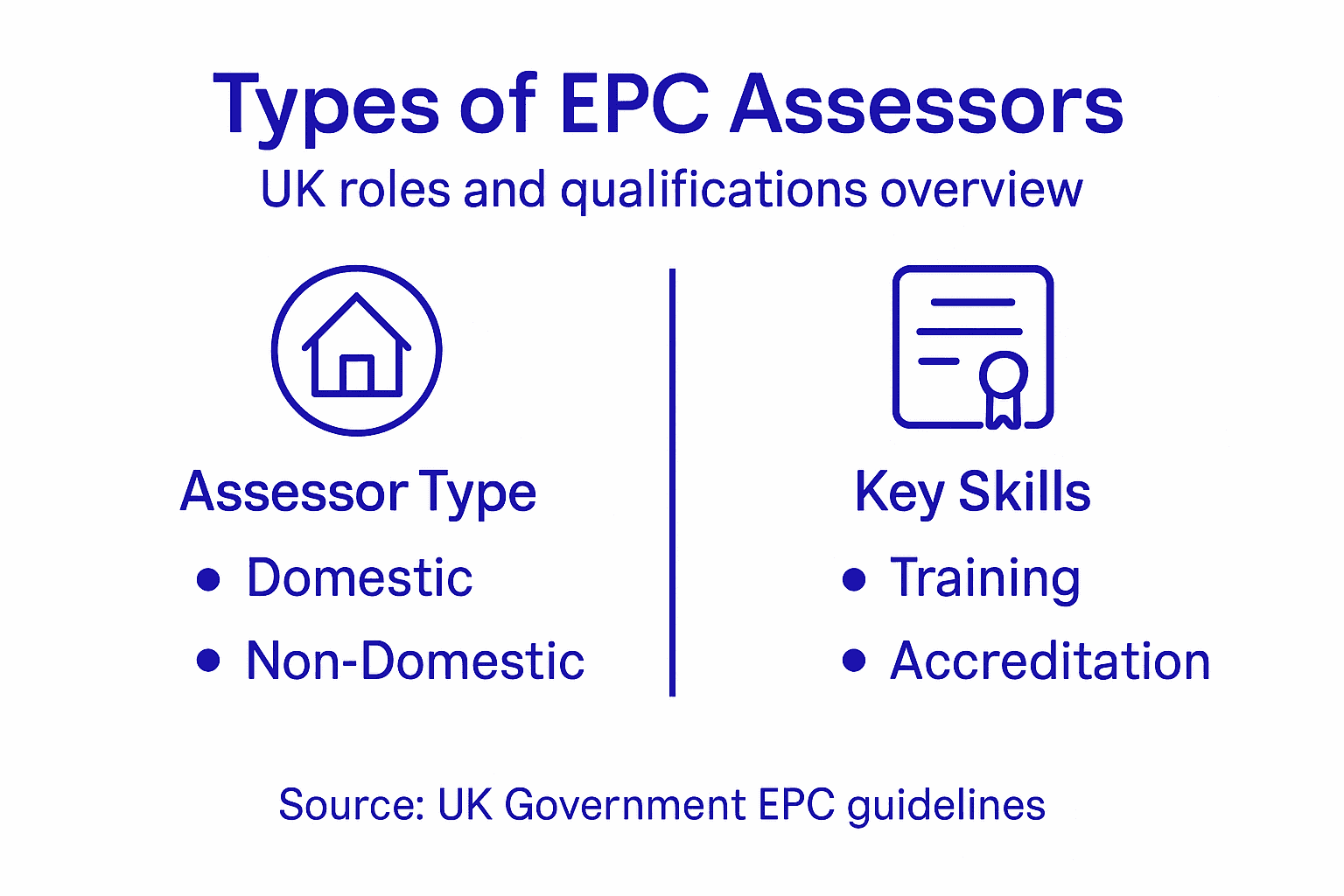
To become a qualified EPC assessor, professionals must complete specific training programmes and obtain accreditation from recognised bodies such as the Royal Institution of Chartered Surveyors (RICS) or the Construction Industry Training Board (CITB). The core qualifications typically involve comprehensive training in building physics, thermal performance assessment, energy consumption analysis, and understanding of current building regulations. Choosing a qualified assessor requires understanding these professional standards and verification processes.
The assessment qualifications involve both theoretical knowledge and practical competence. Assessors must demonstrate proficiency in using specialised software for calculating energy performance, understanding building construction techniques, interpreting technical drawings, and comprehending complex energy efficiency metrics. They are required to stay updated with changing building regulations, emerging energy-saving technologies, and evolving sustainability standards. This continuous professional development ensures that EPC assessors provide accurate, current, and valuable insights for property owners across London.
Pro Tip: Always request to see an assessor’s current accreditation and professional credentials to verify their expertise and compliance with the latest energy assessment standards.
Here is a comparison of Domestic and Non-Domestic EPC Assessors:
| Assessor Type | Property Focus | Typical Clients | Key Areas of Assessment |
|---|---|---|---|
| Domestic Energy Assessor (DEA) | Residential houses, flats, apartments | Homeowners, residential landlords | Insulation, heating, lighting |
| Non-Domestic Energy Assessor (NDEA) | Commercial, industrial, public buildings | Businesses, councils, institutions | HVAC systems, lighting, building fabric |
How the EPC Assessment Process Works
The Energy Performance Certificate (EPC) assessment is a systematic process designed to evaluate a property’s energy efficiency and environmental impact. EPC assessment details reveal that the process typically involves a comprehensive on-site inspection conducted by a qualified energy assessor. During this visit, the assessor meticulously examines critical aspects of the property, including wall construction, insulation quality, heating systems, windows, doors, and lighting configurations.
The assessment follows a structured approach where the assessor collects precise measurements and technical data about the property’s energy characteristics. They utilise specialised software to calculate an energy efficiency rating on a scale from A to G, with A representing the most energy-efficient properties and G the least efficient. EPC application workflow involves detailed documentation and precise technical analysis that goes beyond a simple visual inspection.

Practically speaking, the entire assessment typically takes between 20 to 60 minutes, depending on the property’s size and complexity. The resulting Energy Performance Certificate remains valid for 10 years, unless significant energy-related renovations are undertaken that could materially change the property’s energy performance. Property owners receive a comprehensive report that not only provides an energy efficiency rating but also includes recommendations for potential improvements that could enhance the property’s energy performance and potentially reduce utility costs.
Pro Tip: Prepare for your EPC assessment by gathering documentation about your property’s previous energy upgrades, heating system specifications, and any recent insulation work to facilitate a smoother and more accurate evaluation.
Legal Requirements and Regulatory Obligations
Under current UK legislation, Energy Performance Certificates are mandatory for properties being sold, rented, or constructed. Energy performance regulations specify that residential and commercial property owners must obtain a valid EPC before marketing their property, with significant legal implications for non-compliance. Landlords, in particular, face stringent requirements, including minimum energy efficiency standards that prohibit renting properties with extremely low energy performance ratings.
The legal framework surrounding EPCs is comprehensive and continuously evolving. Property owners must ensure their certificates are less than 10 years old and accurately reflect the current energy performance of their buildings. For rental properties, EPC rules for landlords mandate that properties must achieve a minimum Energy Performance Certificate rating of E or higher, with potential financial penalties ranging from £500 to £5,000 for properties failing to meet these standards.
Regulatory obligations extend beyond simply obtaining an EPC. Property owners are legally required to make the certificate available to potential buyers or tenants at the earliest opportunity. This means displaying the EPC prominently during property listings, providing copies during viewings, and including the certificate in sales or rental contracts. Failure to comply can result in substantial financial penalties and potentially impact the property’s marketability, making proactive energy performance management a critical consideration for London property owners.
Pro Tip: Retain all historical energy performance documentation and conduct regular energy efficiency assessments to stay ahead of changing regulatory requirements and potential future compliance standards.
Financial Impact and Mistakes to Avoid
The financial consequences of mishandling Energy Performance Certificates can be substantial for London property owners. EPC compliance deadlines highlight that penalties for non-compliance can range from £500 to £5,000, depending on the property type and severity of the violation. These financial risks extend beyond immediate fines, potentially impacting property value, rental potential, and marketability in an increasingly energy-conscious real estate market.
Common mistakes that lead to significant financial repercussions include failing to obtain a valid EPC before marketing a property, neglecting to address low energy performance ratings, and not maintaining up-to-date certification. Property owners often underestimate the long-term financial implications of poor energy efficiency. A low EPC rating can reduce a property’s market value by up to 20%, making proactive energy improvements a critical financial strategy. EPC rules for landlords emphasise that properties with energy efficiency ratings below E cannot be legally rented, potentially leading to substantial lost rental income.
Beyond direct penalties, there are broader financial considerations for property owners. Energy-inefficient properties typically incur higher utility costs, with poorly rated buildings consuming significantly more energy and resulting in increased monthly expenses. Moreover, upcoming regulatory changes are likely to impose stricter energy efficiency standards, meaning properties that fail to meet evolving requirements may face increasingly severe financial penalties and reduced market attractiveness. Investing in energy improvements is not just a compliance measure but a strategic financial decision that can enhance property value and reduce long-term operational costs.
Below is a summary of financial impacts related to EPC compliance:
| Scenario | Financial Consequence | Impact on Owners |
|---|---|---|
| No valid EPC | £500-£5,000 penalty | Legal fines and reduced marketing opportunities |
| Low EPC rating (F or G) | Cannot legally be rented | Loss of rental income and reduced property value |
| Proactive improvement | Increased property value | Lower bills, greater market appeal |
| Ignoring regulatory changes | Risk of larger penalties | Higher future costs and stricter enforcement |
Pro Tip: Consider conducting a comprehensive energy audit before your EPC assessment to identify potential improvements that could boost your property’s energy rating and prevent costly compliance issues.
Ensure Your EPC Assessment Meets London’s Rigorous Standards with Trusted Experts
The article highlights the vital role of qualified EPC assessors in delivering precise energy performance evaluations for properties across London. Many property owners face challenges like understanding complex legal requirements, avoiding costly penalties, and correctly preparing for the assessment process. With regulations continuously evolving, relying on experienced professionals is essential to secure accurate Energy Performance Certificates that comply with UK standards and ultimately protect your investment.
At Complete EPC, we specialise in providing comprehensive EPC services tailored to both domestic and commercial properties in London. Our team of accredited assessors offers detailed reports with clear improvement recommendations designed to enhance your property’s energy efficiency and market value. Avoid common pitfalls such as invalid certificates or low energy ratings by choosing experts who understand every step of the EPC process. Visit our professional EPC services page today to start your seamless journey towards full compliance and long-term savings. Act now to benefit from competitive pricing and the peace of mind that comes from working with London’s trusted EPC consultancy.
Frequently Asked Questions
What are the main responsibilities of an EPC assessor?
EPC assessors evaluate the energy performance of properties by assessing insulation, heating systems, and energy consumption patterns. They provide detailed insights for property owners on energy efficiency and recommend improvements.
How long does an EPC assessment typically take?
An EPC assessment usually lasts between 20 to 60 minutes, depending on the property’s size and complexity, as assessors meticulously examine critical aspects of the property.
How often do I need to renew my EPC?
An Energy Performance Certificate remains valid for 10 years. However, if significant energy-related renovations occur, a new assessment should be conducted to reflect the updated energy performance.
What are the consequences of not having a valid EPC when renting out a property?
Failure to obtain a valid EPC can lead to penalties ranging from £500 to £5,000, and properties rated below E cannot be legally rented, resulting in lost rental income.