

By 2030, minimum EPC rating of C required for all privately rented homes, yet many London landlords remain uncertain about upcoming changes. Energy Performance Certificates, critical for legal lettings under MEES regulations, are undergoing significant reforms starting 2025. These reforms introduce stricter assessment methods, expanded metrics, and tighter timelines that demand immediate landlord attention. Understanding what changes, when they take effect, and how to comply protects your rental income and avoids penalties.
Table of Contents
- Introduction To EPC And Importance Of Upcoming 2025 Standards
- Detailed Overview Of EPC Changes Effective 2025 To 2030
- New EPC Assessment Metrics And Methodology Transformations
- Cost And Exemption Framework For Landlords Under 2025 Reforms
- Enforcement, Penalties, And Legal Risks Of Non-Compliance
- Future Outlook: EPC Reforms Beyond 2025 And Preparation Strategies
- How Complete EPC Supports London Landlords With 2025 Standards Compliance
Key takeaways
| Point | Details |
|---|---|
| Minimum rating increases to C | All private rentals must achieve EPC rating C by 2030, with new tenancies requiring compliance by 2028. |
| RdSAP 10 launches June 2025 | New assessment methodology providing more accurate energy performance data replaces current system. |
| Multi-metric evaluation introduced | Four new headline metrics assess fabric, heating, costs, and smart readiness beyond single score. |
| Cost caps and exemptions expanded | £10,000 improvement limit rises to £15,000 by 2030; extended exemptions available for qualifying properties. |
| Penalties for non-compliance | Fines reach £4,000 plus public naming for breaches exceeding three months. |
Introduction to EPC and importance of upcoming 2025 standards
Energy Performance Certificates rate property energy efficiency on a scale from A (most efficient) to G (least efficient). Under current Minimum Energy Efficiency Standards, landlords cannot legally let properties rated below E. These certificates guide tenants on expected energy costs and help property owners identify improvement opportunities.
The UK government is raising standards to reduce carbon emissions and improve housing stock energy performance. Existing regulations leave gaps in enforcement consistency and assessment accuracy. The 2025 reforms address these shortcomings whilst accelerating the transition to higher efficiency properties across London’s rental market.
Current landlord obligations include:
- Valid EPC certificates for all marketed rental properties
- Minimum rating of E before new tenancy commencement
- Register exemptions with local authorities where improvements prove unaffordable
- Renewal of expired EPCs every ten years or upon substantial property alterations
The reforms aim to tighten these requirements significantly. Understanding what is an EPC provides essential foundation knowledge. Landlords must recognise why Londoners need an EPC to appreciate compliance urgency. Government guidance on EPC 2025 reforms outlines comprehensive policy changes affecting thousands of rental properties.
Property owners face mounting pressure to upgrade energy performance whilst managing costs. The transition from E to C rating represents substantial investment for many older London properties. Recognising EPC requirements in London prevents rushed, expensive last-minute upgrades.
Detailed overview of EPC changes effective 2025 to 2030
From 15 June 2025, EPC assessments updated to RdSAP 10, introducing enhanced data verification and calculation precision. This methodology shift affects how assessors evaluate properties and generates different ratings compared to legacy systems. Landlords with borderline ratings may see scores change under the new method.
The government mandates minimum EPC rating of C by 2030 for all private rentals. This represents a two-band uplift from current E requirements. New tenancies must meet this standard earlier, creating a phased compliance timeline that varies by lease commencement date.
Compliance deadlines follow this structure:
- June 2025: RdSAP 10 methodology becomes mandatory for all new assessments
- April 2028: New tenancies require minimum EPC rating C
- April 2030: All existing tenancies must achieve EPC rating C regardless of start date
- Transition rule: Properties achieving C rating before October 2029 remain compliant until EPC expiry
| Deadline | Requirement | Property type |
|---|---|---|
| 15 June 2025 | RdSAP 10 assessments mandatory | All residential |
| 1 April 2028 | Minimum EPC C for new lets | Private rentals |
| 1 April 2030 | Minimum EPC C universal | All tenancies |
| Before 1 Oct 2029 | Grace period if C achieved | Transitional properties |
EPC validity periods are changing under the new framework. Certificates now link more closely to tenancy start dates rather than property transaction timings. This ensures ratings remain current when tenants move in, reducing the risk of outdated efficiency data misleading occupants. Understanding key EPC requirements for 2025 helps landlords plan assessment timing strategically.
The EPC overhaul launching June 2025 represents the most significant regulatory change in a decade. Properties previously rated C under old methodology may drop to D under RdSAP 10 due to stricter calculations. Early reassessment identifies affected properties before compliance deadlines loom.

New EPC assessment metrics and methodology transformations
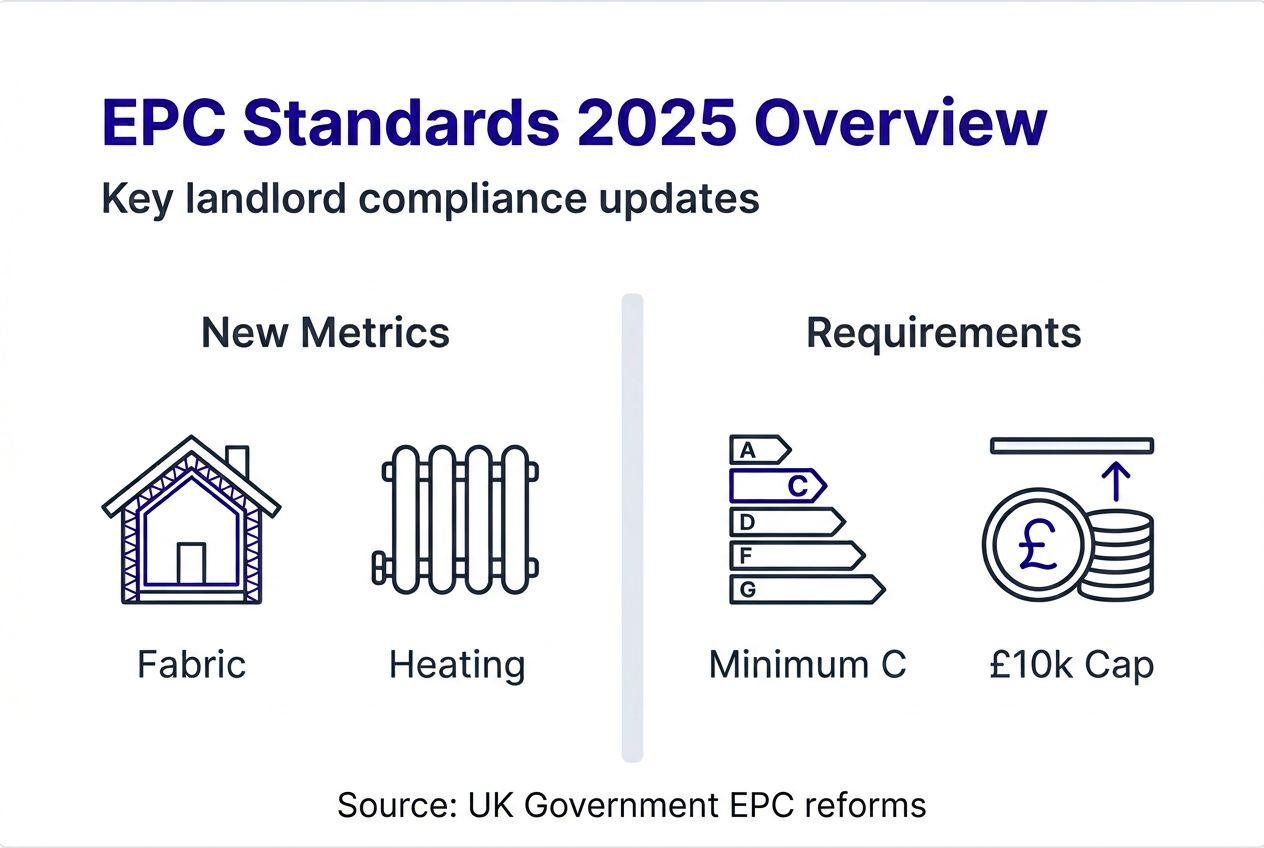
RdSAP 10 introduces multiple metrics including fabric performance, smart readiness, heating system efficiency, and energy cost. These four headline indicators replace reliance on a single overall score. Each metric provides specific insight into different aspects of property energy performance.
Fabric performance measures insulation quality, window efficiency, and building envelope effectiveness. This metric directly reflects how well a property retains heat during winter and stays cool in summer. Properties with solid walls or single glazing typically score poorly here.
Heating system efficiency evaluates boiler age, control sophistication, and renewable technology integration. Modern condensing boilers with smart thermostats score higher than older systems. Heat pumps and solar thermal installations provide additional rating uplift.
Energy cost estimation gives tenants realistic expectations of annual bills based on standardised usage patterns. This transparency helps renters budget accurately and compare properties fairly. Lower costs correlate with higher efficiency ratings.
Smart readiness indicator assesses property capability to integrate intelligent energy management systems. This forward-looking metric rewards buildings prepared for future technology adoption. Properties with smart meters, programmable heating controls, and energy monitoring systems benefit.
| Old system | New system |
|---|---|
| Single overall rating | Four distinct metrics |
| Limited transparency | Detailed performance breakdown |
| Generic recommendations | Targeted improvement guidance |
| Static assessment | Future-ready evaluation |
These changes enable landlords to prioritise improvements strategically. Rather than guessing which upgrades yield best results, the multi-metric approach pinpoints specific weaknesses. An energy efficiency metrics guide clarifies how each indicator influences overall ratings.
Pro Tip: Focus fabric and heating improvements first, as these metrics carry heaviest weighting in final EPC scores under RdSAP 10.
The detailed breakdown helps landlords avoid wasting money on low-impact upgrades. For example, installing solar panels without addressing poor insulation delivers minimal rating improvement. The new system reveals such imbalances clearly. Government resources on multi-metric EPC reforms provide technical specification details.
Landlords can target upgrades more precisely using this granular data. Properties strong in fabric but weak in heating efficiency require different interventions than those with opposite profiles. This precision reduces unnecessary expenditure whilst maximising rating improvement. Learning how to improve EPC ratings in London becomes more scientific and cost-effective.
Cost and exemption framework for landlords under 2025 reforms
The government sets a £10,000 cost cap for required energy efficiency improvements, protecting landlords from excessive financial burden. This limit rises to £15,000 by 2030 as technology costs decrease and installer competition increases. Landlords who reach the cap without achieving rating C can claim exemption.
Exemptions provide crucial relief where compliance proves technically impossible or economically unviable. The reforms introduce extended validity and increased exemptions compared to current rules. Properties in conservation areas, listed buildings, or with specific construction limitations may qualify.
Available exemptions include:
- High cost exemption when improvements exceed the applicable cap
- Technical feasibility exemption for properties where required works are impractical
- Consent exemption when planning permission or building consent is refused
- Devaluation exemption if improvements reduce property value by more than five percent
- Temporary exemption for newly acquired properties pending compliance work
Exemptions now last up to ten years for qualifying properties, double the previous five-year maximum. This extended exemption period acknowledges that some properties require longer planning and implementation timescales. Short-term holiday lets under specific occupancy thresholds gain exclusion from MEES entirely.
A critical transitional provision states that properties rated EPC C or above before 1 October 2029 retain compliance until their certificate expires. This grace period rewards early action and provides breathing room for landlords who upgrade proactively. Properties achieving C rating in 2026 under RdSAP 10 secure compliance until 2036, assuming standard ten-year validity.
Pro Tip: Document all improvement costs meticulously with invoices and assessor quotes to support potential exemption claims if the cap is reached.
Understanding EPC essentials for London owners helps evaluate which exemptions might apply to specific properties. The government’s cost and exemption update guidance provides detailed eligibility criteria and application processes.
Landlords should assess exemption eligibility before undertaking expensive works. Some properties will never achieve rating C due to inherent constraints. Knowing this early prevents wasting funds on futile attempts. Professional assessors can evaluate technical feasibility and estimate costs accurately.
Enforcement, penalties, and legal risks of non-compliance
Local authorities enforce MEES regulations through inspection programmes and complaint investigations. Breaches lasting more than three months trigger maximum fines up to £4,000. Councils publish non-compliant landlord details publicly, creating reputational damage beyond financial penalties.
Enforcement officers cross-reference EPC registers with tenancy databases to identify potential violations. This data-driven approach increases detection rates significantly compared to reactive complaint systems. Properties advertised for rent without valid certificates or with sub-minimum ratings face swift action.
Legal consequences extend beyond fines:
- Tenancies commenced without compliant EPCs may be invalidated
- Rental income from non-compliant properties could be deemed illegal proceeds
- Mortgage lenders may call loans on properties in persistent breach
- Insurance coverage might be voided for non-compliant rental properties
- Future licensing applications could be rejected based on compliance history
Reputational damage affects landlord businesses substantially. Tenant review platforms increasingly highlight EPC ratings and energy efficiency. Properties with poor ratings struggle to attract quality tenants willing to pay premium rents. Word spreads quickly in local rental markets when landlords cut corners on legal requirements.
Non-compliance not only risks financial penalties but may render leases illegal, harming landlord credibility and future business prospects across London’s competitive rental market.
Property values suffer when EPC ratings lag behind neighbourhood averages. Buyers discount acquisition prices for properties requiring expensive efficiency upgrades. This devaluation often exceeds the cost of proactive improvement works undertaken before sale. Understanding EPC legal compliance workflows protects asset values long term.
Government resources on enforcement and penalties detail the full scope of consequences facing non-compliant landlords. The financial and reputational costs far exceed investment in timely compliance. Early action demonstrates professionalism and protects business sustainability.
Tenant satisfaction directly correlates with energy efficiency. Cold, expensive-to-heat properties generate complaints, poor reviews, and higher turnover. These operational costs compound penalty risks, making compliance economically rational beyond legal necessity.
Future outlook: EPC reforms beyond 2025 and preparation strategies
Policy evolution continues past 2030 with potential further standard increases. Industry observers anticipate minimum rating B requirements for some property types by 2035. Commercial properties face separate timelines with commercial EPC requirements tightening progressively.
Multi-metric EPC adoption expands through late 2026 as assessors gain RdSAP 10 proficiency. Early adopters benefit from assessor learning curves, potentially securing more favourable ratings as methodology interpretation matures. Waiting until deadlines loom means competing for limited assessor availability at peak demand pricing.
Landlords should implement these preparation strategies:
- Audit current EPC ratings using RdSAP 10 methodology to identify properties requiring immediate attention
- Budget improvement costs within applicable caps and prioritise properties with nearest compliance deadlines
- Engage certified assessors familiar with new methodology for accurate baseline evaluations and upgrade recommendations
- Target fabric improvements first, as insulation and glazing upgrades deliver maximum rating uplift per pound invested
- Install smart heating controls and renewable technology where feasible to capture smart readiness indicator benefits
- Document all improvement expenditure meticulously for exemption claims if cost caps are reached
- Monitor government consultations and policy updates quarterly to anticipate regulatory shifts before they take effect
- Plan retrofit projects across multiple properties strategically to spread costs over several years and optimise cash flow
Proactive landlords gain competitive advantages through early compliance. Properties achieving rating C now command premium rents as tenant awareness of energy costs increases. Marketing compliant properties becomes easier as rating transparency improves through multi-metric certificates.
The impact of commercial EPC certificates on business operations demonstrates efficiency benefits beyond residential contexts. Office landlords recognise that superior ratings attract environmentally conscious corporate tenants willing to pay higher rents. This dynamic increasingly applies to residential markets too.
Future policy will likely incentivise renewable heating technology adoption more aggressively. Heat pumps, solar thermal systems, and district heating connections may become prerequisite for top ratings. Landlords planning long-term portfolio retention should evaluate renewable integration now. Understanding the importance of commercial EPC for London offices reveals efficiency priorities likely to cascade into residential requirements.
Remaining informed about policy evolution protects against surprises. Government consultations invite stakeholder input before finalising regulations. Participating in these processes ensures landlord perspectives influence policy development. Industry associations provide regular updates tracking legislative progress.
How Complete EPC supports London landlords with 2025 standards compliance
Navigating the 2025 reforms requires expert guidance tailored to London’s diverse property stock. Complete EPC provides comprehensive support helping landlords achieve and maintain compliance efficiently. Our qualified assessors specialise in RdSAP 10 methodology, delivering accurate ratings that withstand regulatory scrutiny.
We guide property owners through every compliance step, from initial assessment to targeted retrofit planning. Our detailed reports identify which improvements yield best rating uplift within your budget constraints. This strategic approach minimises costs whilst maximising compliance outcomes. Understanding EPCs through our London guide clarifies the entire certification process.
Our EPC assessment process ensures smooth, timely certification without disrupting your property operations. We handle scheduling, conduct thorough evaluations, and deliver certificates rapidly. This efficiency helps landlords meet tight deadlines confidently. Learning EPC essentials for London property owners empowers informed decision-making about upgrade investments.
Pro Tip: Engaging a trusted EPC provider early in your compliance planning reduces last-minute stress and helps secure assessor availability during peak demand periods before major deadlines.
Frequently asked questions
What are the key EPC rating changes coming in 2025?
Minimum ratings increase from E to C for private rentals by 2030, with new tenancies requiring compliance by April 2028. The RdSAP 10 assessment method launches 15 June 2025, introducing more rigorous evaluation standards. Multiple performance metrics replace the single score system, providing detailed efficiency breakdowns.
How do the new multi-metric EPC assessments affect landlords?
They deliver granular insight into fabric performance, heating efficiency, energy costs, and smart readiness rather than one aggregate score. This detail enables landlords to target improvements precisely where they deliver maximum rating uplift. Strategic upgrade planning becomes more cost-effective and results-focused.
What financial relief or exemptions are available under the 2025 reforms?
Cost caps limit required improvement spending to £10,000 initially, rising to £15,000 by 2030. Exemptions extend to ten years for qualifying properties facing technical or financial barriers to compliance. Short-term holiday lets below specific occupancy thresholds gain exclusion from minimum rating requirements entirely.
What are the penalties for failing to meet the new EPC standards?
Fines reach £4,000 maximum for breaches exceeding three months, with public naming by local authorities adding reputational damage. Non-compliant leases may be invalidated, creating legal complications beyond financial penalties. Persistent non-compliance affects future licensing applications and mortgage arrangements.