

TL;DR:
- London properties’ EPC ratings significantly impact their market value and energy costs.
- Proper assessment and targeted upgrades can improve ratings, boost value, and ensure legal compliance.
- Choosing experienced, local assessors and planning improvements early ensures maximum benefits.
Many London landlords treat an EPC as a formality. Get the certificate, tick the box, move on. But this approach can cost you far more than you might expect. A/B-rated properties in London can be worth £57,000 to £137,000 more than lower-rated equivalents. That is not a minor detail. This guide explains exactly what EPC assessors do, why their expertise matters for your property, and how to choose the right professional to maximise both compliance and long-term value. Whether you are preparing to let, sell, or simply future-proof your investment, what follows will give you the clarity to act with confidence.
Table of Contents
- What does an EPC assessor do?
- Why EPC compliance matters for London landlords
- How EPC ratings impact property value and energy costs
- Choosing the right EPC assessor: What to look for in London
- What most guides miss about EPC assessors and future compliance
- Get expert EPC assessor support for your London property
- Frequently asked questions
Key Takeaways
| Point | Details |
|---|---|
| EPC ratings boost value | Upgrading your EPC can increase London property value by up to £137,000. |
| Stay ahead of compliance | Preparing early for EPC changes helps avoid fines, voids, and rushed costly upgrades. |
| Choose local expertise | An accredited, London-experienced assessor ensures accurate ratings and practical recommendations. |
| Save with smart improvements | Targeted EPC upgrades can reduce annual energy bills by around 30%. |
What does an EPC assessor do?
An EPC assessor is a trained and accredited professional who visits your property to collect the data needed to calculate its energy rating. Their role is both technical and advisory. They gather detailed information about how your property is built and how it uses energy, then translate that into a rating and a set of practical recommendations.
During a typical assessment visit, the assessor will examine and record:
- Floor areas of all habitable rooms and spaces
- Wall construction and insulation levels, including cavity and solid wall types
- Roof and loft insulation depth and condition
- Window glazing type, including single, double, or triple glazing
- Heating systems, including boilers, heat pumps, and controls
- Hot water systems and their efficiency
- Lighting throughout the property
- Ventilation arrangements and any renewable energy installations
All of this information is entered into RdSAP software, which calculates the overall energy efficiency rating on a scale from A (most efficient) to G (least efficient). The software models how the property performs under standardised conditions, so the rating reflects the building itself rather than the habits of its current occupants.
A good assessor does not simply hand over a certificate and leave. They explain the findings in plain English, highlight which improvements would have the most impact, and tailor their advice to the specific type of property. This matters in London, where the housing stock ranges from Victorian terraces and Edwardian conversions to purpose-built 1970s flats and modern new-builds. Each property type presents different challenges and opportunities.
“An EPC is only as useful as the advice that comes with it. A knowledgeable assessor helps you understand not just where you stand, but what you can realistically do about it.”
Pro Tip: Ask your assessor to walk you through the recommendations verbally before they leave. Understanding which measures offer the best return for your specific property is far more valuable than a printed list alone.
Why EPC compliance matters for London landlords
Understanding what assessors look for, it’s crucial to see why their findings matter — first and foremost, for compliance and value.
The Minimum Energy Efficiency Standards (MEES) require that all privately rented properties in England and Wales meet at least an E rating before a tenancy can be granted or renewed. For London landlords, this is a legal baseline, not a suggestion.
Here is a clear summary of the key compliance milestones and penalties:
| Requirement | Detail |
|---|---|
| Current minimum rating | E rating for all rental properties |
| Penalty for non-compliance | Fines of £5,000 or more |
| Future target (new tenancies) | C rating required from 2030 |
| EPC validity period | 10 years from date of issue |
| Additional risks | Problems with landlord insurance and tenancy agreements |
The financial consequences of ignoring these requirements are significant. Non-compliance does not just mean a fine. It can affect your ability to secure landlord insurance, create disputes with tenants, and leave you unable to legally market the property.
Beyond fines, there is a running cost argument too. Properties rated E or below typically cost their occupants considerably more to heat and power. The energy cost gap between a well-rated home and a poorly-rated one can reach £1,200 to £1,600 per year. That difference does not go unnoticed by prospective tenants.
Here are the three most important steps to stay compliant right now:
- Check your current EPC rating and confirm it is still within its 10-year validity window.
- Identify properties rated D or below in your portfolio as priority targets for improvement.
- Plan upgrades ahead of the 2030 C-rating deadline to avoid rushed, costly works and potential void periods.
Timing matters. Landlords who act now have the advantage of choosing improvements at a measured pace rather than reacting under pressure.
How EPC ratings impact property value and energy costs
The threat of regulation and cost is not the only consideration. The upside for value and savings is even more compelling.
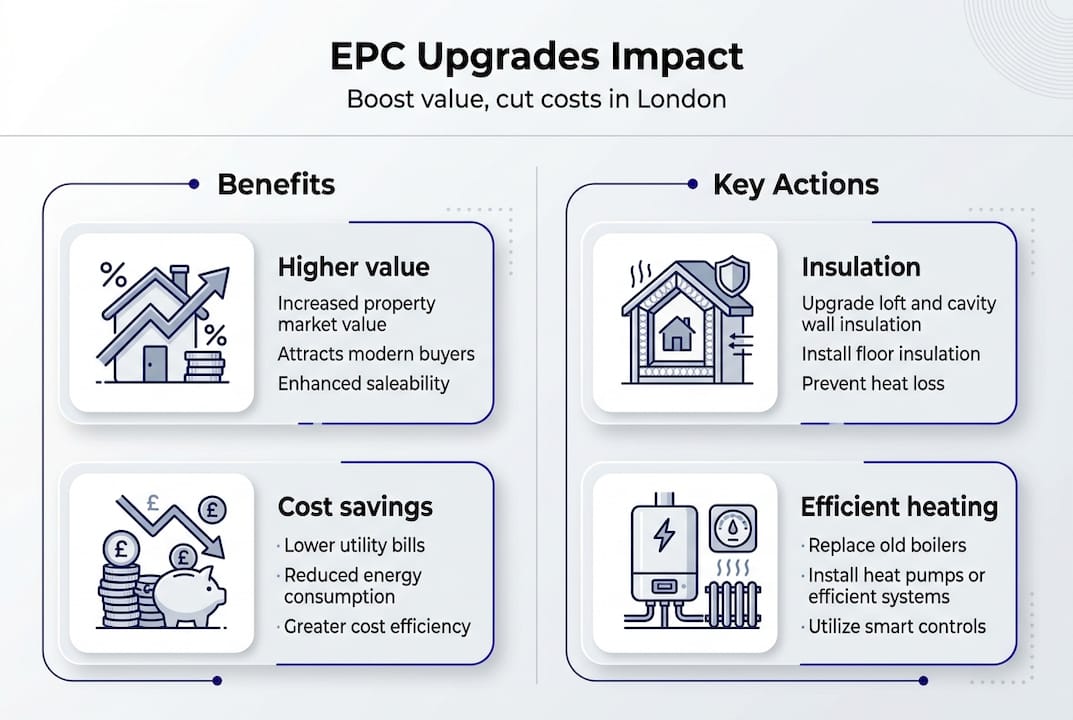
The value premium attached to energy-efficient properties in London is well documented. Improvements can yield 30% savings on annual energy bills, and A/B-rated properties in London can command a price premium of £57,000 to £137,000 over lower-rated equivalents. Around 20 to 30 per cent of homes in the UK still sit below a C rating, which means there is a clear and growing competitive advantage for landlords who upgrade.

Here is how the most common improvement measures affect both ratings and value:
| Improvement measure | Typical rating impact | Estimated annual saving |
|---|---|---|
| Loft insulation (top up to 270mm) | Up to 5 points | £150 to £300 |
| Cavity wall insulation | Up to 10 points | £200 to £400 |
| Replacing old boiler with modern condensing boiler | Up to 15 points | £300 to £500 |
| Double glazing (from single) | Up to 8 points | £100 to £250 |
| Solar photovoltaic panels | Up to 15 points | £400 to £700 |
For landlords managing portfolios across London, the cumulative effect of these improvements is substantial. A property moving from E to C becomes easier to let, commands a higher rent, and carries a stronger sale value when you choose to exit.
- Void risk drops significantly for C-rated and above properties.
- Tenant demand increases as energy bills form a larger part of household budgets.
- Mortgage lender appetite for poorly-rated properties is narrowing, affecting refinancing options.
Pro Tip: If you are planning a refurbishment anyway, co-ordinate it with an EPC improvement plan. Combining insulation, heating, and glazing works in a single project almost always costs less than tackling each in isolation.
The jump from D or E to C is the single most impactful move you can make right now, both for compliance and market positioning.
Choosing the right EPC assessor: What to look for in London
To get the best possible results and to ensure recommendations are genuinely relevant, you need to choose your assessor wisely.
Not all EPC assessors offer the same level of service. Qualifications are a starting point, but local knowledge and practical experience with London property types are equally important. A Victorian mid-terrace in Hackney presents very different challenges from a purpose-built flat in Canary Wharf, and your assessor should understand both.
When evaluating assessors, look for the following:
- Accreditation with a recognised scheme such as Elmhurst Energy, Stroma, or ECMK
- Experience with London’s varied housing stock, including period properties and conversions
- Transparent pricing with no hidden fees
- Clear turnaround times for the certificate, particularly if you are working to a letting deadline
- Positive customer reviews from landlords and property owners specifically
One of the most underused tools available to you is the draft EPC. Draft EPCs help landlords evaluate improvements before lodging an official certificate, allowing you to model different upgrade scenarios and choose the most cost-effective path. Rather than commissioning expensive works and hoping for the best, a draft EPC gives you data-backed confidence before you commit a penny.
Here is how to prepare your property for assessment so the visit runs smoothly:
- Ensure full access to all rooms, the loft, and the boiler cupboard.
- Gather documentation including boiler installation records, insulation certificates, and any planning permissions for extensions.
- Note any recent upgrades such as new windows, insulation, or heating controls, even if you no longer have the paperwork.
- Clear loft access so the assessor can measure and inspect insulation without obstruction.
A well-prepared property visit means the assessor captures accurate data first time, which leads to a more precise and reliable rating. Inaccurate data, even if unintentional, can result in a lower rating than your property actually deserves.
What most guides miss about EPC assessors and future compliance
Most EPC guides focus on meeting the current minimum standard and leave it there. That approach made sense five years ago. It no longer does.
The 2026 reforms are introducing new metrics for EPCs, including fabric performance, heating system type, running costs, and smart readiness. With RdSAP10 now live, a property that scrapes through on today’s methodology may perform quite differently under the updated framework. Quick fixes like switching a light bulb brand or adding a basic thermostat are not going to be enough.
The landlords who will be in the strongest position by 2030 are those who treat EPC improvement as a strategic investment rather than a last-minute compliance exercise. That means using draft EPCs to model improvements now, understanding which fabric upgrades provide long-term gain, and sequencing works intelligently rather than reacting to deadlines.
We have seen landlords spend significant sums on rushed improvements in the final months before a compliance deadline, only to find that a more measured approach would have cost far less and achieved a better rating. The lesson is simple: plan early, use expert advice, and let data guide your decisions. The assessor is not just a certificate provider. They are your starting point for a smarter property strategy.
Get expert EPC assessor support for your London property
If you are ready to take control of your property’s energy performance and compliance, working with a locally experienced, accredited assessor is the most important step you can take. At Complete EPC, we support landlords and property owners across London with accurate assessments, clear recommendations, and some of the most competitive rates in the UK. Explore our EPC assessment process guide to understand exactly what to expect, or read our energy performance certificate guide for a full overview of your obligations and options. When you are ready to book or want tailored EPC rating advice for your specific property, our team is here to help you move forward with confidence.
Frequently asked questions
How long is an EPC valid and when do I need a new one?
An EPC is valid for 10 years and must be renewed before you market a property for sale or rental again. If your certificate has expired, you cannot legally let or sell the property until a new assessment is completed.
What happens if my property does not meet the minimum EPC rating?
Letting a property that fails MEES compliance can result in fines of £5,000 or more and may cause problems with your landlord insurance and tenancy agreements. You must reach at least an E rating before granting or renewing any tenancy.
How much can upgrading my EPC rating save me?
Improving from E to C can reduce energy bills by approximately 30% per year, with the exact saving depending on the property size and the measures installed. This makes the investment in upgrades financially worthwhile in most cases.
What is a draft EPC and why might I need one?
A draft EPC is a preliminary version of your certificate that lets you evaluate improvements before lodging the official document. It helps you identify the most cost-effective upgrades and avoid spending money on measures that deliver little rating benefit.